Depending on the size of your event/march/demonstration/rally/etc it may warrant some people to be designated as marshalls, stewards, or ushers. I will be using any of the terms throughout this document as if they are all the same.
- The lead stewards should walk the route. This should be done on the same day of the week and at about the same time as the actual march is going to take place so that a real world knowledge is gained. Take note of any construction, hazards, detours, etc that may affect your march. The pace should be the same as a marching/walking crowd. Time your walk. This information should also be given to the planning group so that they are aware of those aspects of the logistics of staging the event.
- The route should try and avoid left hand turns for safety reasons.
- One way roads are great
- Avoid going counter to the flow of traffic (walk into a one-way roadway against the traffic)
- Take note of washrooms, hazards/obstacles, etc so that this information can be shared with the rest of the team and the planning/action group
- Mark out on a map the route and anything of note (use the tools in Google Maps) and then print it out – or share it.
- If the end of the march has different tents and such the stewards should know where things are since people will be asking them for directions and such (Is there food, are there toilets, is there a first aid tent, etc?). Print out maps for your stewards so they can be a reliable source of information for people.
- The MC or Lead Stewards should announce to the crowd before they start on the route the following guidelines:
- we are non-violent peaceful
- explain the route and the structure (layout of stewards) and what will happen at intersections
- what will happen if an emergency vehicle approaches from behind (https://twitter.com/fietsprofessor/status/1653780014289022977?s=20)
- identify stewards with the vests that they will be wearing (it is best if medics have different coloured vests so they are easily identifiable)
- police accompaniment – they are there for our protection. They are doing one of the jobs that they are hired to do
- Position people in wheelchairs and with mobility challenges towards the front of the crowd so that the pace is set by them. Too many times, seniors, wheelchairs, are at the rear and they are pushed to keep up with the crowd ahead of them.
- If you have drummers/horns/etc they should be upfront but check with the seniors and people with mobility challenges in the same area to see if they are okay with the noise level. It would be useful to have some hearing protectors on hand in case anyone needs these for dampening the sound.
- Wear your vest – this identifies you as a steward/marshall
- Be respectful but also maintain safety for the group and individuals – including yourself
- You are there for everyone’s safety – you are the visible barrier to alert motor vehicle operators to give a safe margin around the group.
- Once you depart someone can send tweets out to the police, fire/ambulance, #yegtraffic, and to the transit (there are also phone numbers that can be used). Let them know where you are starting from, where you are going, how many people are in the crowd, how long you will be taking to move from one place to the next, etc.
- I prefer to have emails ready to send to these institutions with full details (and a map if possible) and scheduled to be sent when the crowd should be leaving.
- this allows emergency services and buses to take alternate routes and thus avoid the crowd. They have strategies in place for any disruption that may delay their vehicles.
- I don’t let these services know beforehand since they can throw up objections and request permits. My view is that this is a public right and responsibility to protest and we do not need their permission to protest. I do provide them route information about one hour ahead of time via Twitter – police, transit, fire department, ambulance, #yegTraffic (general Twitter hashtag), etc. If you want more information about permits you can obtain this at the City of Edmonton site.
- If you take up all lanes you will need to decide what to do when emergency vehicles and buses are behind you. This is very rare in Edmonton if you do the preceding step. Usually, emergency vehicles get a pass. The stewards will announce that people should all move towards the curb.
- There needs to be a line of marshals on the left of the crowd (between oncoming traffic and the crowd to ensure that the group does not move over the centre line into oncoming traffic lanes). If we are only in one lane then the marshalls ensure that cars pass safely and that they form a hi-viz barrier to the right of the lane-dividing line
- A minimum of two, but six is more ideal, stewards/marshals at the front of the crowd to ensure that the intersection is safe to enter – we are the critical mass. Once we move into an intersection the WHOLE crowd goes through – we do not observe the traffic lights. depending on the size of the intersection all six may be needed to freeze the intersection. Once the crowd has moved into the intersection other stewards need to take over holding the cross traffic from entering the intersection. The front stewards then move on to the next intersection. If you have enough stewards then you can do a leapfrogging type of process.
- Marshals are there to help maintain the pace and to ensure that there are no gaps in the crowd because this might entice motor vehicle operators to push through the gap which makes an unsafe situation. We should not allow motor vehicles into the perimeter of the crowd. Cars should be excluded.
- The lead marshalls regulate the pace of the march. They need to be aware of the slowest people in the crowd and if the rear of the crowd is keeping up. Some form of communication needs to happen between the rear and the front to ensure the crowd stays tight. See below.
- If a situation needs medical help or assistance please phone the medical team and/or medical services – 911.
- If vandalism or violence breaks out do not put yourself or anyone else in the group in harm’s way. Move away from them to disassociate from that person(s). If you have any de-escalators in the team, call them to help. Pull out your phone to record the situation as it is unfolding. Call 911 if it is serious.
- If you have a camera please start to record the incident because when people know they are being observed they tend not to carry out those kinds of actions.
- Marshalls should not carry things. They are part of the crowd but a little apart. We have the duty of keeping the crowd safe and somewhat orderly.
- Police are our ‘friends’ in this instance. They are doing their job. They will let us walk along the street in a safe and orderly fashion. They will normally provide police vehicles and police on bicycles to accompany us. They will normally secure the intersection so that we can safely pass through it. They will also have a sweeper vehicle (one that comes along behind the crowd to ensure that traffic behind us will not ‘push’ into us.
- Do not share information with friendly police. They are collectors of information and what might be shared innocently could be used against you or someone else.
- The lead marshall or organizer should reach out to the head police officer and exchange phone numbers so that they can easily communicate if there is a problem. We will tell them about our route. They will ask that we take only one lane (the size of the crowd will dictate what number of lanes we take over).
- If you have less than 50 people you will likely be on the sidewalk
- over 50 to about 200, you do one lane
- Over about 250 you can usually hold two lanes of traffic (over 500 for sure two lanes)
- Taking two lanes of traffic is where we want to be since this is a significant presence and is disruptive
- you ALWAYS take the lane(s) in the direction of travel (meaning – you do not walk in the oncoming traffic lanes).
- There will be times when you will ask a participant to do something. They can choose to comply or not. Stewards are not an authoritarian entity. Participants are here out of choice. If they understand why you are asking them to do something then they would more likely comply.
The big banner should be at the very front of the crowd. This is good for photographs. The banner should have a short message about what your goal is – Ceasefire NOW!, Just Stop Oil, End the War, etc. A 3M banner is adequate for one-lane. If you are going to take two lanes of traffic then you should have two 2 – 3M banners (more manageable/flexible). Use the banners to hold people back and sett he pace with them. Remind people to hold the banners straight and such so they are easily readable. Check in with the banner holders to see if they need a break.
A banner in the midst of a crowd is a waste of a banner. If you have a more banners than needed for the front then it is good to use them along the traffic side of the crowd as a barrier between traffic and the marchers. If there are lots of pedestrians you might want to have them along the sidewalk side of the marchers (but the view might be blocked by parked cars).
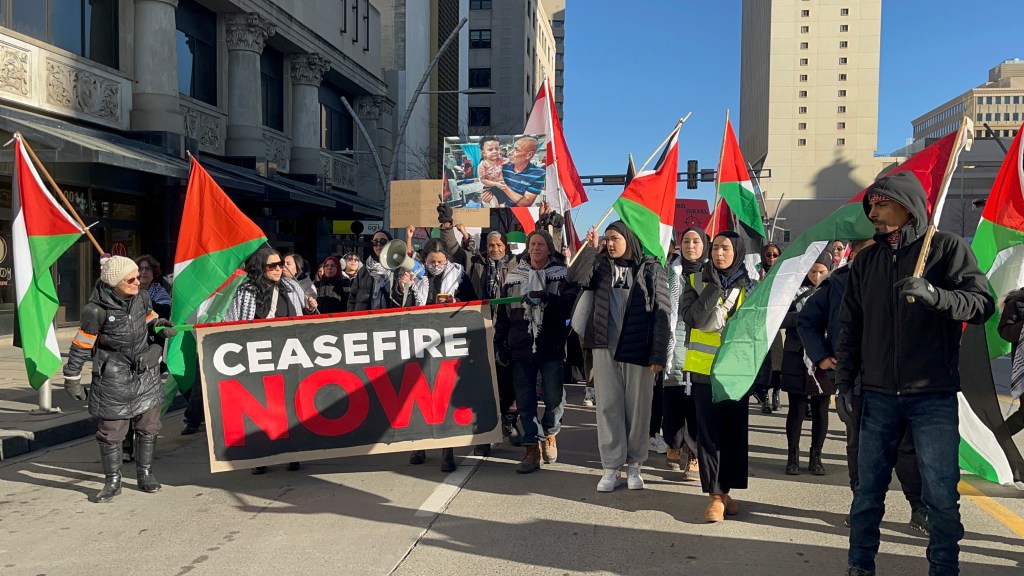
There should only be one person ahead of the banner – the lead marshal, safety facilitator, or march organizer. They decide when to enter the intersection, turn, set pace, etc.
It is about optics, branding (to some extent), and getting your message out there.
It is good to have banners along the sides so that people on the sidewalks and driving past can read what your march is about. It also marks out your boundaries.
Before the police arrive ensure that there are a minimum of 4 stewards at the rear of the crowd. It is nice to have a rear-facing banner so that drivers behind you know what is holding them up. I like to have bicycles at the rear so that it is not just human bodies holding space – but metal.
If there are stewards that have first aid training they should have additional marking on their vests so that they are easily identified and carry a first aid kit with them.
If the crowd blocks in parked vehicles, stewards need to keep an eye on these vehicles since the drivers may want to try and push their way out into traffic. Most stewards are focused on traffic in front, behind, overtaking traffic, and oncoming traffic. So if there are parking areas the lead stewards will have to assign some stewards to protect that side of the crowd. This is why it is a good idea to have banners along the curbside (not only to inform pedestrians why you are there).
We do not block bicycle lanes. Try to keep this lane open at all times. We support bicycle travel. You will have to decide what happens with busses and whether you have a policy around that.
Police Liaison
If you are doing a series of marches it may be beneficial to set up a group of people to liaise with the police and other emergency services beforehand – but only after you have done one or two marches to show them the numbers and how organized you are. This is not going to them for permission but rather to work with them to allow them to allocate their resources a little better.
When the police arrive on the scene direct them to the designated liaison person.
This person should have an overall understanding of what we are doing and why. They should not provide the police with any extra information. Just the basics – where we are going and what route we will be taking. If you are a crowd on the smaller side, they will try and get you to move of onto the sidewalk.
We have a right to protest. The law does not dictate where and when we do that. The UCP government passed the Critical Infrastructure Defence Act (Bill 1). It is mostly about blocking access to industrial sites and deals with highways. Your group will have to decide how disruptive you will be. Also, you will a moving disruption and not a stationary blockage.
You might want to watch this video from The Juice Media about the laws in Australia. Many governments are working to shut down voices of descent. We show up to lend our bodies and voices because it works and we should not let governments intimidate us into silence.
Communication
If the crowd is large, the lead steward should have an assistant that deals with communication. It will be that person’s responsibility to monitor the chat and messages. The lead steward will be busy with other aspects and should not be occupied checking their phone all the time.
One of the main ‘conversations’ will be between the back of the march and the front. The main message will usually be – to “slow down”. It makes sense to have this phrase copied into your clipboard so that you can send the message without typing it each time.
Ask your stewards to ensure that their phones are charged before showing up. It might be wise to have a couple of power banks just in case – along with the appropriate cords/cables.
Walkie-talkies work well but are expensive and only pulled out to do the odd march each year.
Cell phones can be used – see this for a variety of apps to turn cell phones into walkie-talkies https://geekflare.com/best-walkie-talkie-apps/ and the Telegram app can be used as a walkie-talkie platform.
 Activist Agenda